
- September 24, 2024
432 Hz / Myth or Real ?

Story Time
I’m big fan of analog synths and once I noticed that my favorite one is a little off and I need to tune the other ones to it as it was the main character on a track. So I started doing it by ear, it was very easy, I immediately felt where they sit together in the mix, until I brought in to play the piano part which was from Nexus VST instrument. It was tuned for the standard 440 Hz by deafult of course and to finetune it you have to manually write in the numbers. It turned out the correct tuning was 436. Not a big deal but still it gave some character to the sound. If I muted all the drums and percussions which was also tuned by ear than I noticed that if I tune everything to 440 hz the songs still sounds the same, recorded both and did an A/B compairson check. So I came to the conclusion that this 432 Hz myth is just a snake oil or hippie legend. Tuning wont change the basic rules of music as intervals remain the same so the rules of the game still applies no matter what finetune We use.
From a sound engineering perspective, dropping the tune only by a few cents can make a sound sit better as it will drift out of the crowd of sounds and giving a wider feeling such as the classic unison effect. Another common song writer practice is to use inversions of chords to make the voicing sound deeper to make room for other sounds. Folding them thisway creates the same feeling as the original form of chords but with a different articulation that can be more exciting just like bending the rules with custom tuning.
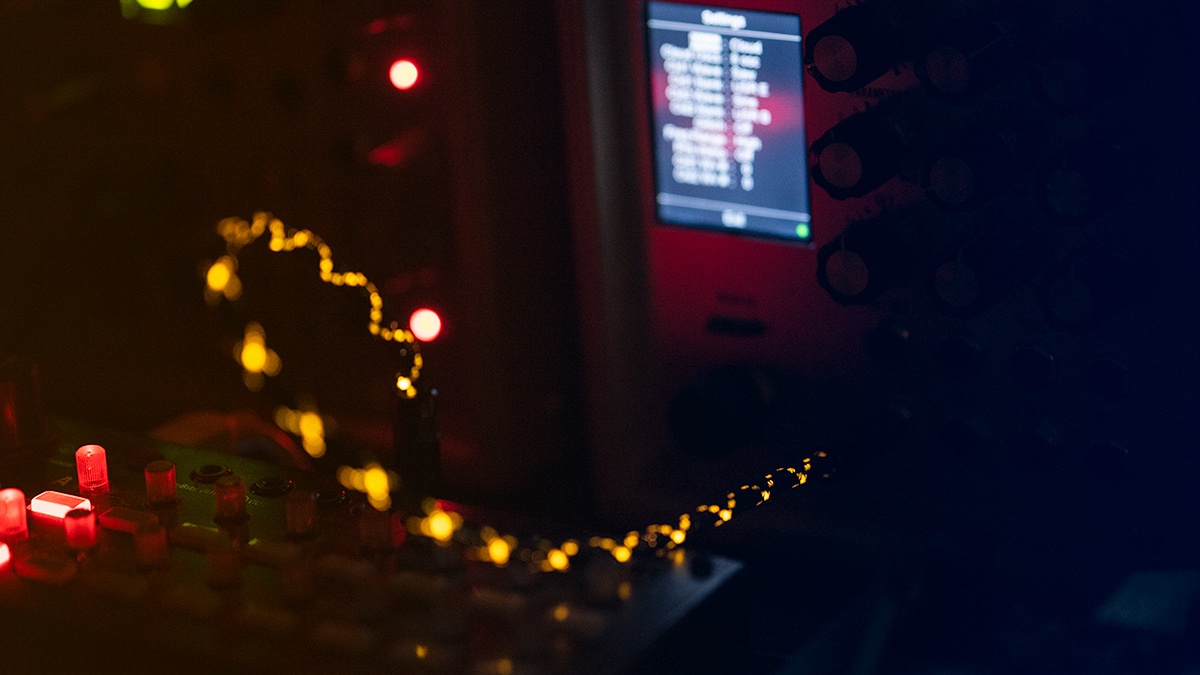
Modular Synths
In the world of modular synths this custom tuning happens quite a lot, and these happy acciedents create really good vibes and unique sounds. Eurorack modules also bring the joy of microtonal movement that our brain recognises in a different way than the usual steps of a traditional intervals. This can be a new and exciting experience. The common problem of tuning with modulars opens up a beautiful world of errors that lead to unique sound design. The tracking of notes slightly drifts thru the octaves, this means some detuning on the scale is inevitable, some voices will be precisely tuned and the further we get from them the more detuning will occur. Now imagine that this happens on two different voices, this means that the chords will have a built in unison effect that fattens the sound or if We see the whole picture the harmony of the track will be suffering from tiny imperfections that leads to add a different feeling than a standard precise 440 Hz tuned world. Other than these errors a sound designer often creates custom tuned patches as the modulations alter the oscillators pitches, these can be ringmodulation, crossover modulation, wavefolding and harmonic generators or comb filters. So as you can see there are plenty of options to f*ck up the precise tuning.

Vintage Synths
A perfect example of the sought after analog detuning is that the Sequential Prophet REV 2 has a built in effect that’s meant to mess with the tuning of the oscillators. It is called OSC SLOP parameter and it simulates the instability of the vintage voice boards which were always a little off compared to each other. This was the secret of the fatness of many vintage analog synthesizers. The faithful recreation of analog detuning went over the top for recent years. Voice Component Modelling was born. The idea behind it is to mimic every building blocks behavior such as Voltage Controlled Oscillators lack of stability by creating ever so slight drifts in pitch OR the browning out factor of old Voltage Controlled Amplifiers by adding harmonics and distortion. Now what relates all this back to the original topic? That back in the day these analog monsters were nowhere near the perfect 440 Hz tuning as they always moved a little. So there is really no point in giving such a powerful role for the tuning. If We start to identify the tuning on a microscopic level We’ll find out that a guitar or any string instrument has a higher pitch in the early phase of the sound, which is also used in synth bass lines to create an easily recogniseable bass tone for house or techno tracks and that’s a quite old trick.